Lilith as WitchMother
Mazikim - 2 classes
fallen angels & half supernatural/half humn
Lilin-"begotten of Adam on the one side and Lilith...on the other.
Shedim
born from relations (sexual) with 2 angels (Aza & Azael-Lord of the Waves & the Waters, King of the Host of the Sea) with Na'amah-daughter of Lamech-great-great grandson of Enoch. Shedim can "Assume any shape & form they like and are able to see without being seen themselves.
Adam begat Cain, who begat Enoch, who begat Enoch, who begat Methushael, who begat Lamech-who begat Tubal Cain & Na'amah with his wife Zillah.
Cain was a Lilin.
Agrimus was the 1st born of Adam & Lilith-therefore the first Lilin...
Sunday, December 27, 2015

Tuesday, December 22, 2015


Friday, September 18, 2015
Preparations for the final Demon King ritual in association with the Tetrad Full Blood Moon Eclipse
The concept for the final Demon King ritual in direct
association with the Tetrad-Full Blood Moon Eclipse on September 27th,
2005 is composed of representation of AIR of AIR and WATER of WATER or True
WATER and AIR. In this format-WATER of WATER is the Tarot card Queen of Cups,
and AIR of AIR is the King of Swords. So the ritual should be Elementally
balanced. In this approach-although influenced by the energies of the Dual
Queens-Cups and Wands. Although this is auspicious, as Mahazuel/Mahalakla is the
Northern intermediary for Lilith as the WitchMother/WitchQueen. The alignment
of the energies feel spot on-and condusive to what the intentions of the ritual
are. Interestingly enough-as the original intentions of the series of Demon
King workins were like a ‘meet-and-greet’ between me and the 4 Kings for future
work-now-I feel that not only have they graciously accepted the formal
introductions-but they have laid a foundation on which to build and a direction
in with to go-with this final ritual.
The energies described will give us Mutable, Cardinal, and
Kerubic forms, Expanding EARTH, Active AIR and WATER, and the Stability of
WATER through the link to FIRE via the WATER of FIRE assimilation by placement
of the birth signs of the particpants. My personal Expansion energy will couple
nicely with the stabilizing energy of the participant opposite me-in the
North/South continuum, for pulling the energy of the Phurpa as Axis Mundi in
the center of the sacred space-grounded by the dual current of the other participants-as
Active AIR/WATER-East/West. That in and of itself is a form of Circle-in the
perspective of ‘Cone of Power’ concept-as the energy will be pulled from the
North-Mahazuel/Mahakala and charge in the center as the Phurba/Axis Mundi-and
cannot leave the sacred space via the stable/grounding energy-which will
project back to the center-As Above-So Below. “One of the principal methods of
working with the Phurba/kila and the actualize its essence-quality is to pierce
the earth with it, sheath it, or as is common with Himalayan shamanic
traditions, to penetrate it vertically, point down into a basket, bowl or cache
of rice )or other soft grain if the kila is wooden) The terms employed for the
deity and the tool are interchangeable in Westeren scholarship. In the
Humalauan shamanic tradition the kila may be considered as axis mundi
(Muller-Ebelling 2002) affirm that for the majority of Nepalese shamans, the
kila is cognate with the world-tree, either in their visualizations or in
initiatory rites or other rituals. The kila is used as a ritual implement to
signify stability on a prayer ground during ceremonies, and only those
initiated in its use, or otherwise empowered, may wield it. The energy of the
kila is fierce, wrathful, piercing, affixing, transfixing. The kila affixes the
elemental process of “Space (Sanskrit” Akasa) to the Earth, thereby
establishing an energetic continuum. The kila, particularly those that are
wooden are for shamanic healing, harmonizing, and energy work and often the two
nagas (Sanskrit for snake serpent, or dragon, also refers to a class of
supernatural entities or deities) entwined on the blade
On the blade, reminiscent of the staff or Asclepius and the
caduceus of Hermes. Kila often also bear the ashtamangala, swastika, sauwastika
and/or other Humalayan, Tantric, or Hindu iconography or motifs. The magick of
the Magickal Dagger comes from the effect that the material object has the
realm of the spirit. The art of tantric magicians or lamas lies in their
visionary ability to comprehend the spiritual energy of the material object and
to willfully focus it in a determined direction (Muller-Eberling 2002) “Without
the Phurba inside himself, the shaman has no consciousness” ‘the shaman himself
is the phurba, he assumes its form in order to fly into other worlds and
realities. So in essence we are establishing a
‘energetic continuum’ by utilizing the phurba being ‘otherwise empowered’
as the axis mundi centered in the ‘prayer ground’. This is be beyond a shadow
of a doubt an initiatory rite on some-level-for everyone involved. “By Names
and Images are All Powers Awakened and Re-Awakened.”
Now-the point where the energies of Mahazuel and Mahakala
are fused via the EARTH/FIRE North/South continuum is important. The
Black/EARTH Mahazule candle will be lit when Mahazuel is evoked, and then after
Mahakala is evoked and gifted the Red Coral-the Combined Black/Red EARTH/FIRE
candle of the North/South continuum will be lit, and the dual energies will be
evoked together. The mallow candle will be lit in the center of the Demon
Cauldron-placed upright in the rice-this should help maintain control over the
energies.
Via the StarCircle, Mahazuel is evoked via his sigil through
the energies/personification of the Planetary influences of Mercury in the North-via
the Sefirot HOD-and Mahakala will be evoked via his sigil through the energies/personification
of the Planetary influences of Venus in the South-via the Sefirot NETZACH. In
essence this should establish the energies of Mahazuel as Intellectually
ground/practical-and Mahakala as affectionately fiery/impassioned. This energy
should be very auspicious for the transmutation of the dual aspects of the King
energy-although the grounding nature of the Expanding EARTH and the Stable
WATER will be necessary.


The Black sigilized Mahazuel candle that mysteriously fell over and broke during the last ritual involving the 4 Demon Kings (2014)

The new Black/Red-sigilized Mahazuel/Mahakala candle that will be lit from the old Black Mahazuel candle in the upcoming full blood moon eclipse ritual.
Sunday, August 30, 2015
Cain the childe of Lilith
"He who is the Son of the Lady-Night
Cain the childe of Lilith
mother of all abominations
from whose womb brought forth those with a darkling
nature
But perhaps we say too much..."
Totemic Invocation of Shadow Selves
~Jack Macbeth~
(Orland Britts)
Cain the childe of Lilith
mother of all abominations
from whose womb brought forth those with a darkling
nature
But perhaps we say too much..."
Totemic Invocation of Shadow Selves
~Jack Macbeth~
(Orland Britts)
Friday, July 3, 2015
Tsakli or Initiation cards
Tsakli (also “tsakalis”) are Tibetan Buddhist miniature paintings, normally produced
as thematic groups or sets, whic

Melek Taus
The subjects found on tsakli are similar to the better
known larger Tibetan thangka scroll paintings on cloth, but much
simpler, usually showing only a single deity, or a pair. The subjects are
usually deities or ritual objects and offerings associated with these deities
are represented on the tsaklis. Occasionally, Tibetan inscriptions on the
backside can identify the subjects which are painted on the front.
The tsakli which are normally painted in sets which
can comprise from 6 to almost 100 small paintings of similar subjects are used
as offerings in temples or in rituals. For example, before a temple building is
started, the area can be marked with tsakli representing protective deities. In
this case they are mounted on small wooden sticks. Similarly tsakli can be used
by a buddhist lama to remove evil influences from a sick
person, from a tree which does not bear fruit or a stack of grain which is
going to be thrashed. A tsakli can also be placed in a portable shrine or box
(Tibetan “gau”) and carried as a device giving protection to the traveller or
pilgrim who carries this box around the neck or on a shoulder strap.
The majority of tsakli are painted on cloth (like most of the
tangkas) or cardboard. There exist also tsakli which
are printed from woodblocks on cloth or paper. Larger sets of tsakli are kept
between two wooden covers in a similar manner as pages of Tibetan books are
protected.
Tsakli are
traditionally assembled into sets and may represent Buddhas, Bodhisattvas,
Yidams, Gurus, mantras, sacred symbols and ritual implements. They are an
important visual aid when conferring empowerments. The vast majority of these
images are painted on cloth.
Many
Mongolian miniature paintings were actually worn in an amulet box or kept
inside a portable shrine and were revered as efficacious protection amulets.
Among the numerous items employed in Tibetan
ritual is a genre of miniature painting little known in the occident and rarely
spoken of in the liturgical literature translated into western languages. These
are the 'Tsakli' or 'Initiation Cards' .Tsakli paintings are employed in
numerous ritual situations such as empowerment, ritual mandalas, transmission
of teachings, substitutes for ceremonial items, visualization aids and
funerals. The subjects depicted in tsakli cover a vast range from main deities
and protectors to their various power attributes and appropriate offerings.
While tangka paintings often depict these subjects in rich detail, tsakli are
unique in that they generally focus on just one item at a time. One card may
have a Mahakala, for example, another card would depict the vajra attribute,
another the rosary of heads, another may have the skull cup and so on. This
individualized approach may add up to form an entire mandala set of cards with
over a hundred paintings.To facilitate visualization during ritual tsakli are sometimes briefly shown to the initiates by the officiating lama by simply holding the card at arms' length, or they may be held by a stick as part of other ritual items in the altar. Sometimes the cards being displayed in an altar are changed gradually over a course of several days as a series of teachings unfold or they may be integrated with torma offerings to form a tridimensional mandala. Tsakli with the guardians of the four quarters may be set up facing the appropriate directions during the construction of a new monastery building. Or they are placed singly within a portable altar called Gau to be carried during a long journey. Tsakli often serve as substitutes for ritual items which are difficult to procure such as precious stones of different colors, or flayed skins of demons.
To facilitate visualization during ritual tsakli are sometimes briefly shown to the initiates by the officiating lama by simply holding the card at arms' length, or they may be held by a stick as part of other ritual items in the altar. Sometimes the cards being displayed in an altar are changed gradually over a course of several days as a series of teachings unfold or they may be integrated with torma offerings to form a tridimensional mandala. Tsakli with the guardians of the four quarters may be set up facing the appropriate directions during the construction of a new monastery building. Or they are placed singly within a portable altar called Gau to be carried during a long journey. Tsakli often serve as substitutes for ritual items which are difficult to procure such as precious stones of different colors, or flayed skins of demons.
The materials employed for tsakli are generally either primed cloth or cardboard made by gluing several layers of Himalayan paper. Some very rare sets have been made on very thin sheets of Himalayan mica carefully painted and then trimmed and glued on the edges. Other sets have been made from carved woodblocks and then printed either on paper or cloth. The large sets of tsakli were often carried between wooden covers specially carved to size.
So far, there is no evidence of tsakli use in ancient
Lobsang Lhalungpa notes the spellings tsak-li and
tsa-ka'-li, and adds; "Tsakali are primarily used for single or serial
empowerments. Besides figures of deities, tsakalis also depict every set of
symbols and offerings, including ritual objects. Sometimes a tsakali of a
chosen deity is placed in a traveller's shrine (ga'u)." Tsakali does not
appear to be a Tibetan word but may be derived from a Sanskrit
word or compound.

Thursday, June 25, 2015
San Cypriano- Black Cat Bone of Power
After 3+ months of work-the Black Cat Bone magickal operation concluded last night with the creation and charging of the Bones of Power...
We began the process by setting up the altar...dedicated to San Cypriano, and his historical working with the Black Cat from the Grimoires associated with him.

This extended Working began on the Eve of Good Friday. A Black Cat candle was light-along with San Cypriano incense obtained from Lucky Mojo.

Like all workings that are done-we spread everything out on an old card table, and start to work...

Per the African American folk formulas, as set forth in Both "Hoodoo - Conjuration - Witchcraft - Rootwork" by Harry Middleton Hyatt, and .Zora Neale Hurston's Mules and Men, we began the process.
First we sawed the ends off the bones-which should be the "straightest left hind leg bone", and filled them with 5-finger grass.


This was poked down into the hollow of the bones with a ice pick. According to Hoodoo Herb and Root Magic by Catherine Yronwode-5-finger grass can be utilized for the following:
Next- shavings and small pieces of Lodestone

were added to the interior of the bones.

Lodestone is described by Cat Yronwode "to be held in high regard as a powerful amulet and good luck charm because its strong magnetic influences are thought to attract Power, Favours, and Gifts."
Next, according to the old African American formula-raw cotton, chewed in the mouth until soft-was used to seal the ingredients inside the Black Cat Bone.
Cotton is described in Cunningham's Encyclopedia of Magical Herbs as associated with:
...and perhaps my favorite- Fishing Magic!
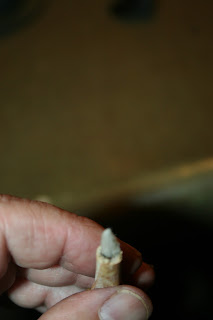
Now you take the separate pieces of Bone and link them back together with black wax. Afterwards you take a $2 and roll the Bone in it.

The deal with the $2 bill is that is it often considered lucky- "Two Buck Luck" Some folks say they're bad luck.
Those who shy from the $2 bill give a variety of reasons they associate with 'Bad Luck":
Aside from ladies of the night, horse races, and bought votes, another reason given as the likely source of the$2 bill's perceived unsavory aspect stems from its most common name: "Deuce" is one of the many slang terms for the Devil himself!
Whatever the cause,$2 bills are widely considered unlucky. For those troubled by this association, superstition offers a counter to two-dollar ill luck: tear a corner from the bill. Some who hold this view assert that one must discard the bill once all its corners are gone.
Then the Bone, wrapped in the $2 was secured with Black Thread.

Next the black thread on the Bone was sealed with black wax. While the wax was hot the metal of San Cypriano was pressed into it-in honor of San Cypriano-as Patron Saint of Sorcererous deeds.


Saint Cyprian , has a long history in association with the Black Cat. In The Book of St. Cuprian: The Sorcerer's Treaure, translated by Jose Leitao-the following specific spells are listed:


Now the Black Cat Bones of Power are filled with 5-finger grass/lodestone, rolled in a $2 bill, and dressed with Van Van oil/Florida Water, and ready to be ritually charged in the Name of San Cypriano as Patron Saint of Sorcery, and in the Infernal Names associated with our personal Cosmology.


We began the process by setting up the altar...dedicated to San Cypriano, and his historical working with the Black Cat from the Grimoires associated with him.

This extended Working began on the Eve of Good Friday. A Black Cat candle was light-along with San Cypriano incense obtained from Lucky Mojo.


First we sawed the ends off the bones-which should be the "straightest left hind leg bone", and filled them with 5-finger grass.


This was poked down into the hollow of the bones with a ice pick. According to Hoodoo Herb and Root Magic by Catherine Yronwode-5-finger grass can be utilized for the following:
- Card-Player's Luck in Gambling.
- Money-Drawing.
- Keeping a Traveler from getting Lost.
- Clear Away Crossed Conditions.
- Protect Your Household.
- Spiritually Cleanse a Jinxed House.
...and interestingly enough-coming Full Circle regarding my own Hexen work-In Pow-Wow or The Long Lost Friend by John George Hohman, it is described to "be used to Gain a Favor, '...certainly obtain that which you desire."
Next- shavings and small pieces of Lodestone

were added to the interior of the bones.

Lodestone is described by Cat Yronwode "to be held in high regard as a powerful amulet and good luck charm because its strong magnetic influences are thought to attract Power, Favours, and Gifts."
Next, according to the old African American formula-raw cotton, chewed in the mouth until soft-was used to seal the ingredients inside the Black Cat Bone.
Cotton is described in Cunningham's Encyclopedia of Magical Herbs as associated with:
- Luck.
- Healing.
- Protection.
- Rain.
...and perhaps my favorite- Fishing Magic!

Now you take the separate pieces of Bone and link them back together with black wax. Afterwards you take a $2 and roll the Bone in it.

The deal with the $2 bill is that is it often considered lucky- "Two Buck Luck" Some folks say they're bad luck.
Those who shy from the $2 bill give a variety of reasons they associate with 'Bad Luck":
- At one time a session with a prostitute cost $2, thus possession of one of those bills proved its holder had been consorting with ladies of the evening. Under this line of thought, at the very least the bill at some point in its career had been through a joy house and was now forever tainted.
- In the days when election-rigging was the norm, campaign bosses would hire men to vote for their candidate. The ringers would be trucked in, given names from the voters' list to claim as their own, and the name of the man they were to vote for. Once they'd done the deed, they would each be rewarded with a
$2 bill. The same fellows would be moved from polling place to polling place, each time to assume new names, vote for the same guy, and be paid again. Having$2 bills in your wallet was therefore proof you'd sold your vote.
- The standard bet in American horse racing was two dollars, and winners were paid with
$2 bills. Ergo, possession of a sheaf of these notes was prima facie evidence that one had been betting on the hay burners. Given the prohibitions against gambling (in the not-so-distant past it was considered an activity thoroughly steeped in sin), no respectable person wanted to be associated with it, not even by happenstance.
Aside from ladies of the night, horse races, and bought votes, another reason given as the likely source of the
Whatever the cause,
Then the Bone, wrapped in the $2 was secured with Black Thread.

Next the black thread on the Bone was sealed with black wax. While the wax was hot the metal of San Cypriano was pressed into it-in honor of San Cypriano-as Patron Saint of Sorcererous deeds.


Saint Cyprian , has a long history in association with the Black Cat. In The Book of St. Cuprian: The Sorcerer's Treaure, translated by Jose Leitao-the following specific spells are listed:
- Great Magic of the Fava Bean.
- Magic of the Bone of the Black Cat's Head.
- Magic from the hairs of Black Cats 'copulating'.
- Execute Vengeance on an Enemy utilizing a Black Cat Bone.
- Generating a tiny devil with the eyes of a Black Cat.
Now the Black Cat Bones need to be 'dressed' with Van Van Oil, and Florida Water.
Van Van oil is sometimes associated wtih "Opening the Way to Visions and/or Psychic Clarity" Sticks, Stones, Roots, and Bones: Hoodoo, Mojo & Conjuring with Herbs by Stephanie Rose Bird.
- Some of the properties of Van Van oil traditionally are:
- Banishing and Clearing Evil
- Purification
- Ritual Preparation
- Protection
- Meditation
- Turnaround-back luck becomes best luck, and poor investment turn into abundance
- Good luck in Money, Business, Gambling, and Love.
- As a Road Opener.
Traditionally Van Van Oil is believed to have come from New Orleans LA, specifically in the West Bank district of Algiers, across the river from the French Quarter.


Florida Water or Eau de Cologne water is next. Florida Water is used in rituals of home protection and spiritual cleaning, to scent bowls of water set out for the spirits of the dead, as a basis for making an ink-dyed scrying water, to draw gambling luck and for other ritual and cosmetic purposes among people of African-diaspora descent in the United States and the Caribbean.


Working with San Cypriano is a very personal process-based to a great extent on an Individuals magickal congress with the Saint-and the ritual work involved.
One of the things I was shown via Spiritual Congress in direct association with the Black Cat Bone working-is that after the initial exhuming of the Black Cat skeleton-a bone is gifted to the Saint, transforming him from the Traditional Catholic Saint-in purple robes-to the Sorceress Patron Santos dressed in Black/Red. As such-the traditional purple candle of the Saint transforms

Into the Black/Red energies of the San Cypriano candle sigilized with the Ponto of San Cypriano (Exu by Nicholaj de Mattos Frisvold, and Drum & Candle: First-Hand Experiecnes and Accounds of Brazilian Voodoo and Spiritism by David St. Clair...

Salve!
Most Holy San Cypriano
Patron Santos of Sorcererous Deeds!
May you Infuse these Black Cat Bones
with POWER!
with the Powers of the Infernal Realm
with the Powers of the Sorcerer's Path
with the Powers of the Crossroads
with the Powers of the Old Magick!
I Beseech you San Cyrpiano!
I Beg you San Cypriano!
I Pray to you San Cypriano!
Salve!
Amen!

Monday, June 8, 2015
Tailsman for BRYSOUS- 2nd Decan of Virgo
"The second decan of Virgo is Brysous and has the
following form: the head of a horned goat, wrapped in bandages down to the
feet, holding in his right hand a sceptre and in his left a jar [canopic?]. It
regulates conditions of the bowels. Engrave it on the stone dendrites [probably
coral], place beneath it the plant liquorice set in what you wish and bear with
me. It gives blessed relief, but you must abstain from the flesh of
crane."
~The Sacred Book of Hermes to Asclepius~
The Testament of Cyprian the Mage
Jake Stratton-Kent
Jake Stratton-
BRYSOUS-2nd Decan of Virgo-Angelick Spirit for healing
(Bowels)
Talisman
Talisman

Background color-Golden Dawn Princess scale (for manifestation in ASSIAH-the physical realm) Cerise rayed pale Green
Symbols color-Violet or
Filter/Buffers:
Divine Sefirot Name-(Hod) ELOHIM TZABAOTH-"God of Hosts"
Atziluth Realm: Planetary- Mercury-RAPHAEL
Briah Realm: Elemental- EARTH-AURIEL
Yetzirah Realm: Astrological- Virgo- RAPHAEL
Assiah Realm: 2nd Decan of Virgo- BRYSOUS
Divine Sefirot Name-(Hod) ELOHIM TZABAOTH-"God of Hosts"
Atziluth Realm: Planetary- Mercury-RAPHAEL
Briah Realm: Elemental- EARTH-AURIEL
Yetzirah Realm: Astrological- Virgo- RAPHAEL
Assiah Realm: 2nd Decan of Virgo- BRYSOUS
Tarot Card- Ten of Pentacles
Stone-Dendrites

Herb-Root of Licorice

Subscribe to:
Posts (Atom)